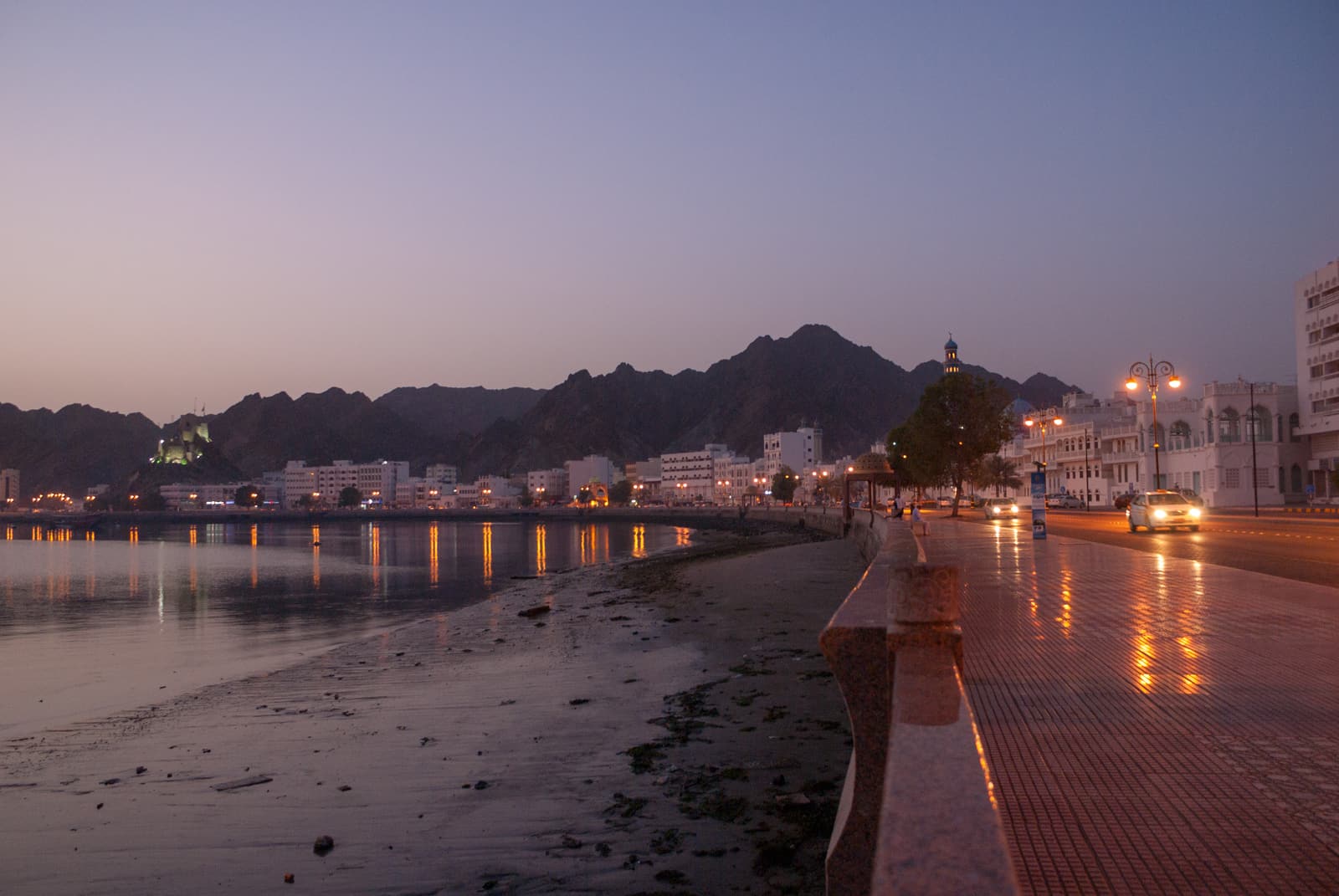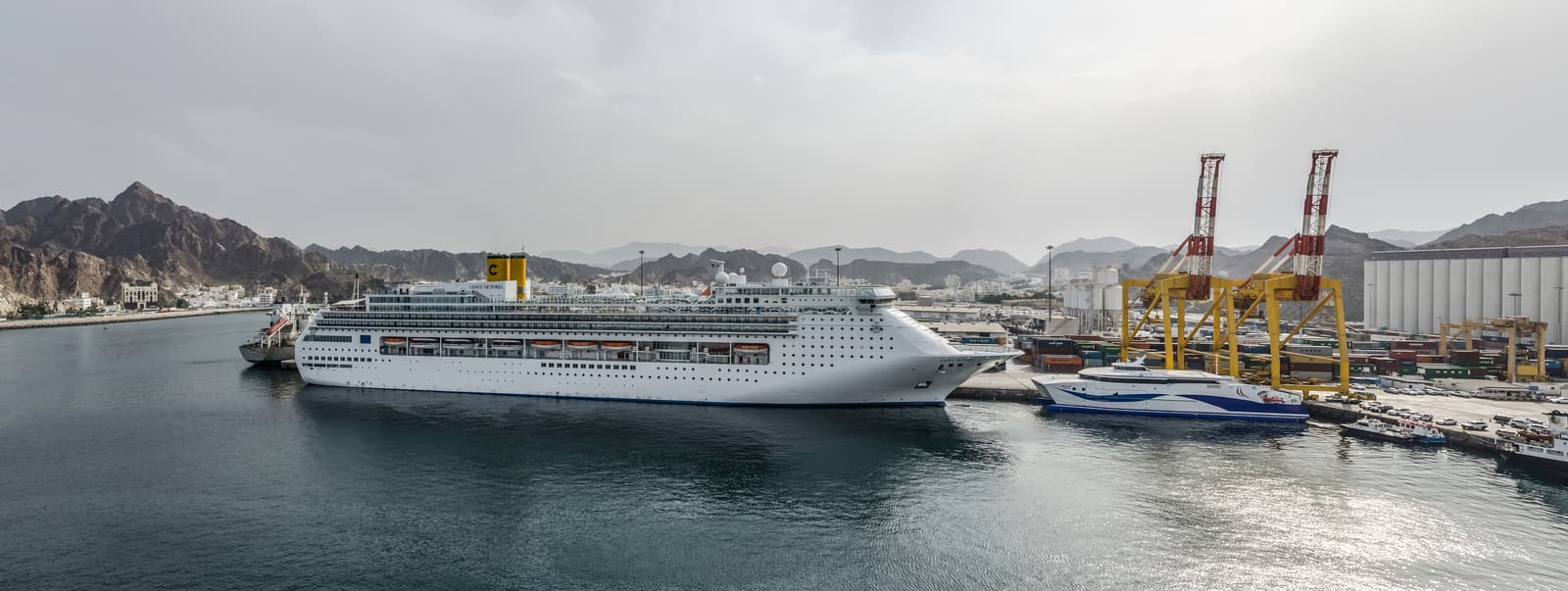
Almost everyone arrives in Muscat one of three ways: by air into Muscat International Airport (MCT), by cruise ship into Port Sultan Qaboos at Mutrah, or overland from the United Arab Emirates. Once here, the challenge is distance — the city runs along the coast for some fifty kilometres, and there is no metro.
The main ways in, compared
| How | Time | Rough cost | Good to know |
|---|---|---|---|
| Flight into MCT | Direct from Europe ≈ 6–8 h | Varies | Modern terminal, 30–40 min from Mutrah |
| Flight from Dubai | About 1 h 10 min in the air | Often inexpensive | Fastest link between the two cities |
| Bus from Dubai | About 5–6 h incl. border | Low | Mwasalat coaches; carry your passport |
| Private transfer from Dubai | About 5 h | From ≈ €490 per car | Door to door, border handled for you |
| Cruise ship | Docks at Mutrah | Included | Walk to the souq in 10–15 minutes |
Arriving by air
Muscat International Airport opened its large new terminal in 2018 and sits in the west of the city, roughly 15–20 minutes from Qurum and 30–40 minutes from Mutrah and Old Muscat without traffic. Oman Air and a long list of Gulf, European and Asian airlines fly in, with frequent short hops from Dubai, Doha, Abu Dhabi and Bahrain.
- Taxi: official airport taxis wait outside arrivals and charge set fares. Confirm the price before you set off.
- Ride-hailing apps: local apps such as Otaxi operate in Muscat and are often cheaper than the rank.
- Pre-booked transfer: a fixed-price private car with a driver in arrivals — the least stressful option after a late flight. See transfers and tours.
- Bus: Mwasalat, the national bus company, runs city routes that serve the airport; they are cheap but slow if you have luggage.
- Car hire: the international firms have desks in arrivals. Driving is on the right and the roads are excellent.
Visas
Oman is one of the easiest countries in the region to enter. Citizens of a long list of countries — including most of Europe — can currently stay visa-free for up to 14 days, and others can apply for an eVisa online through the Royal Oman Police before travel. Your passport should be valid for at least six months. Rules do change, so always check the official ROP eVisa website shortly before you fly.
Arriving by cruise ship
Cruise ships berth at Port Sultan Qaboos in Mutrah, at the eastern end of the corniche. From the gate it is a flat 10–15 minute walk to Mutrah Souq and the fish market, and about 3 km along the corniche to Old Muscat. The Grand Mosque, however, is roughly half an hour away by road in the west of the city — and it admits visitors only in the morning and is closed to tourists on Fridays. If the mosque is your priority, book a half-day city tour with port pickup or take a taxi straight there as soon as you are ashore.
The cruise season runs roughly from October to April. On busy days several ships are in port at once; taxis at the gate are plentiful but prices are higher than elsewhere, so agree the fare first.
By road from Dubai
The drive from Dubai to Muscat is roughly 450 km and takes five to six hours including the border, usually via the Hatta or Al Wajajah crossings. Mwasalat runs daily coaches between the two cities; journey time is similar and fares are low. A private transfer costs far more but is door to door. Flying takes just over an hour and is often the most sensible choice if time matters.
Getting around Muscat
- Taxi and ride-hailing: the default for visitors. Street taxis do not always use meters, so agree a fare before getting in, or use an app.
- Car hire: the best option if you plan day trips. Highways are fast and signposted in Arabic and English; speed cameras are everywhere. Jebel Akhdar requires a 4x4 at the police checkpoint.
- Buses: Mwasalat’s city buses are clean and cheap and link Ruwi, Mutrah, Qurum, the airport and Seeb, but services are infrequent by European standards.
- Hop-on hop-off bus: a sightseeing bus links the main city sights and is convenient for cruise passengers.
- On foot: Mutrah Corniche and Old Muscat are walkable, and the corniche is lovely in the evening. Elsewhere, distances and heat make walking impractical.
Day trips without a car
Wadi Shab, Nizwa, Jebel Akhdar and the Wahiba Sands are all two to three hours from Muscat and poorly served by public transport. If you do not want to drive, an organised day trip is usually cheaper and easier than a taxi for the day — see our tour comparison.